Conference AV Rental That Keeps Events On Track
A conference can have strong content, a solid venue, and a full registration list – and still fall flat if the production side is treated as an afterthought. Conference AV rental is not just about getting a few speakers and a screen into a ballroom. It is about making sure every presenter is heard, every visual is seen clearly, every cue happens on time, and every room works the way it needs to from load-in to teardown.
That matters whether you are planning a leadership summit for 80 people, a multi-day corporate meeting, or a conference spread across keynote space, breakout rooms, and exhibitor areas. The right AV partner helps you avoid preventable issues, control your budget, and reduce the number of moving parts your team has to manage.
What conference AV rental really includes
When clients first ask about conference AV rental, they are often thinking about the obvious pieces – microphones, projectors, speakers, and screens. In practice, a successful conference setup usually involves much more than that.
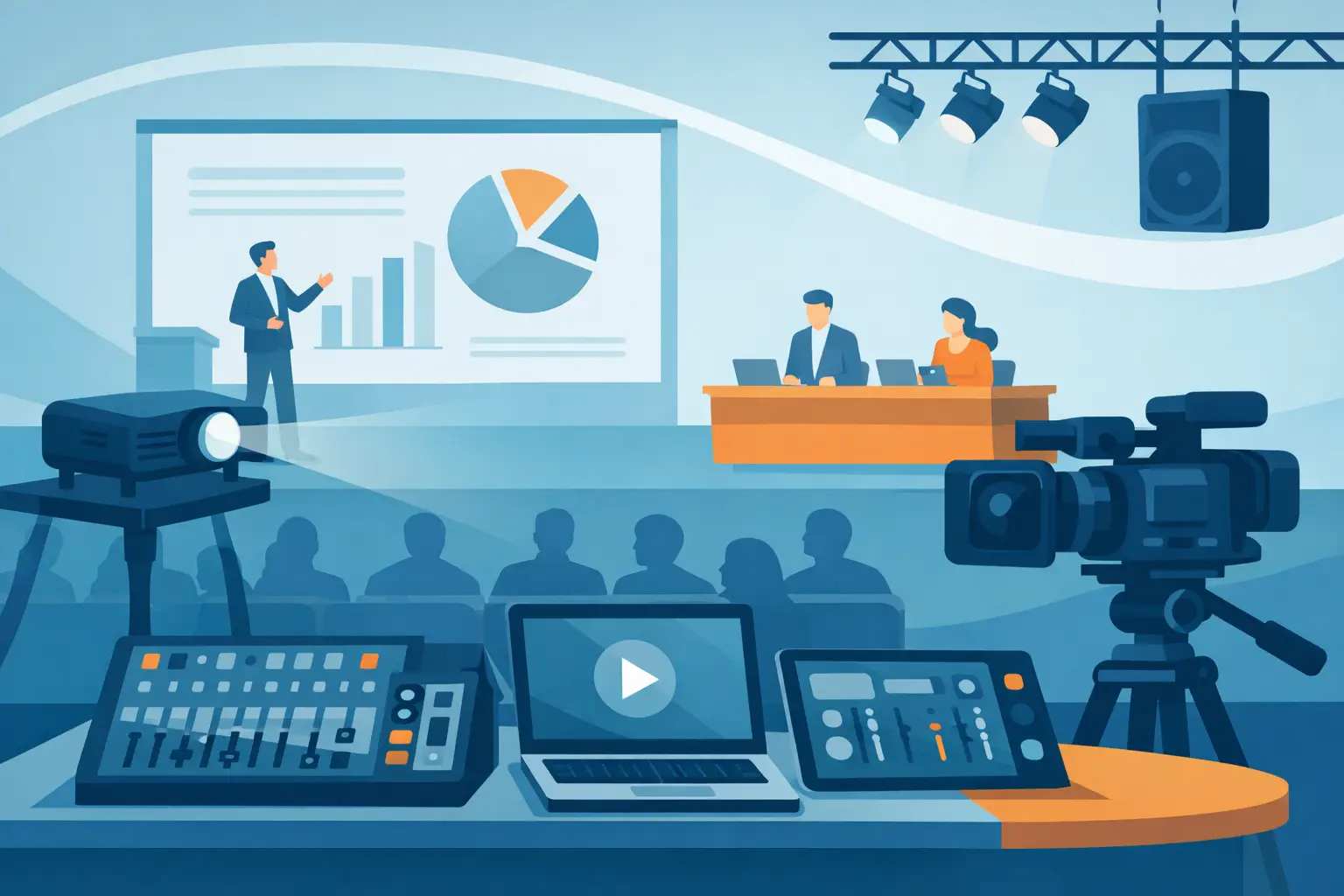
Audio is usually the first priority because poor sound is the fastest way to lose a room. That can include wireless handhelds for audience Q and A, lavalier microphones for presenters, podium microphones, mixers, powered speakers, confidence monitors, and playback support for video or walk-in music. In larger spaces, proper speaker placement and tuning matter just as much as the gear itself.
Visual support is the next big category. Depending on the room size, lighting conditions, and content format, that may mean projector rental, large format displays, switchers, presentation laptops, comfort monitors, or LED video wall rental. A simple slide deck in a hotel meeting room has very different needs than a general session with branded motion graphics and live camera feeds.
Lighting and staging often get overlooked in early planning, but they affect both visibility and perceived quality. Even modest stage lighting can make speakers look more polished on stage and on camera. Stage risers, pipe and drape, lecterns, and scenic elements help define the room and support the agenda, especially for executive presentations, panels, and awards segments.
Then there is the part many first-time planners do not anticipate: labor and show support. Setup crews, operators, stage managers, and on-site technicians are often what keep an event running smoothly when there is a last-minute deck update, a microphone swap, or a presenter who plugs in a laptop five minutes before they go live.
How to scope conference AV rental without overbuying
One of the most common mistakes in conference planning is renting too little equipment for the agenda. The second most common is renting far more than the event actually needs. Both create problems.
The best way to scope conference AV rental is to start with the event flow, not the equipment list. How many rooms are active at the same time? Will presenters use slides, video, or hybrid call-ins? Is there a panel discussion that needs multiple wireless microphones? Does the keynote room need image magnification for a long audience throw? Will general sessions be recorded or streamed?
Those questions affect the gear package more than the guest count alone. A 150-person meeting with multiple content formats can be more technically demanding than a 400-person presentation with one speaker and one screen.
Budget also has to be tied to priorities. If the keynote room drives the attendee experience, that is usually where the strongest investment belongs. Breakouts may need clean, dependable audio and basic screen support, but not every room needs the same level of production. A good production partner will help you allocate budget where it has the most impact instead of pushing a one-size-fits-all package.
Why one vendor matters for conference production
Conferences become harder to manage when audio, video, lighting, staging, and labor are split across multiple vendors with separate timelines and separate assumptions. On paper, that approach can look flexible. In reality, it often creates gaps in communication and accountability.
If the screen placement conflicts with the stage layout, who owns the fix? If the projector spec does not match the room lighting conditions, who catches that before show day? If a breakout needs a last-minute microphone move, who is already on site and ready to handle it?
Working with one provider for conference AV rental and related production services usually leads to faster planning, cleaner logistics, and fewer handoff issues. It also gives the client one point of contact from pre-production through live operation. That is especially valuable for corporate teams managing a lot of parallel tasks or for planners traveling in for events in cities like Los Angeles, San Diego, San Francisco, or Las Vegas where local crew coordination and venue timing can get tight.
What to ask before you book conference AV rental
A rental quote only tells part of the story. The better questions are about execution.
Ask who is handling pre-event planning and whether the provider reviews your run of show, room layouts, venue access schedule, and presenter needs. Ask whether setup, testing, show operation, and teardown are included or quoted separately. Ask how they handle backup equipment for critical components like microphones, playback, and presentation switching.
It is also smart to ask about staffing assumptions. Some events truly can run as a dry rental with gear drop-off and pickup. Many conferences cannot. If your event has executive speakers, audience interaction, session transitions, or multiple rooms turning over quickly, on-site technical support is not a luxury. It is part of risk management.
Finally, ask how the AV plan adapts if the venue changes a detail late in the process. Ceiling height, power access, rigging restrictions, union rules, and loading dock windows can all affect the final setup. A dependable partner does not just send equipment. They think through the operational realities before those issues become expensive.
Conference AV rental for different event formats
Not every conference is built the same, so the right AV approach depends on the format.
For general sessions, coverage and visibility are everything. The audience needs to hear every word clearly, and the room has to support a professional visual experience from the front row to the back. That often means stronger audio reinforcement, larger displays, stage lighting, and a staffed control position.
For breakout rooms, consistency matters more than spectacle. Presenters need simple, reliable systems that are easy to use and reset between sessions. The best setups are usually straightforward and well supported rather than overly complex.
For trade show or sponsor areas inside a conference, the AV needs shift again. Small PA systems, monitors, LED displays, accent lighting, and power distribution may all come into play, especially when exhibitor visibility is part of the event value.
For hybrid or recorded sessions, the conversation changes from room AV to content capture. Cameras, video switching, audio feeds, streaming support, recording workflows, and presenter confidence monitoring all need to be planned as part of one system. This is where experience matters because what works for the in-room audience is not always enough for virtual viewers.
The trade-off between rental-only and full-service support
There are times when simple conference AV rental is the right choice. If your team has in-house technical staff, the agenda is straightforward, and the venue is easy to work in, renting equipment without full production management can save money.
But there is a line where lower upfront cost creates higher event-day risk. If your internal team is already stretched, if the venue has tight access windows, or if the program includes multiple speakers, video playback, room transitions, or executive visibility, full-service support tends to pay for itself. Fewer errors, faster troubleshooting, and clearer accountability are hard to quantify on a spreadsheet, but they are easy to notice when something goes wrong.
That is why many organizers look for a partner that can do both. Some events only need gear. Others need design, staffing, operation, and someone who can own the full production picture. GeoEvent works in both modes, which gives clients flexibility without forcing them into a package that does not fit.
Choosing a conference AV rental partner with confidence
At a minimum, your AV provider should be able to explain the plan in plain language, identify likely pressure points, and build around your agenda instead of around a canned inventory sheet. The strongest partners are detail-oriented before the show, calm during the show, and responsive when plans shift.
That is what conference support is really about. Not just equipment in the room, but experienced people behind it, practical planning around it, and a setup that helps your presenters look prepared and your attendees stay engaged.
When the production is handled well, nobody talks about the microphones, the switcher, or the projector brightness. They remember a conference that felt organized, looked polished, and stayed on schedule – which is exactly how it should be.