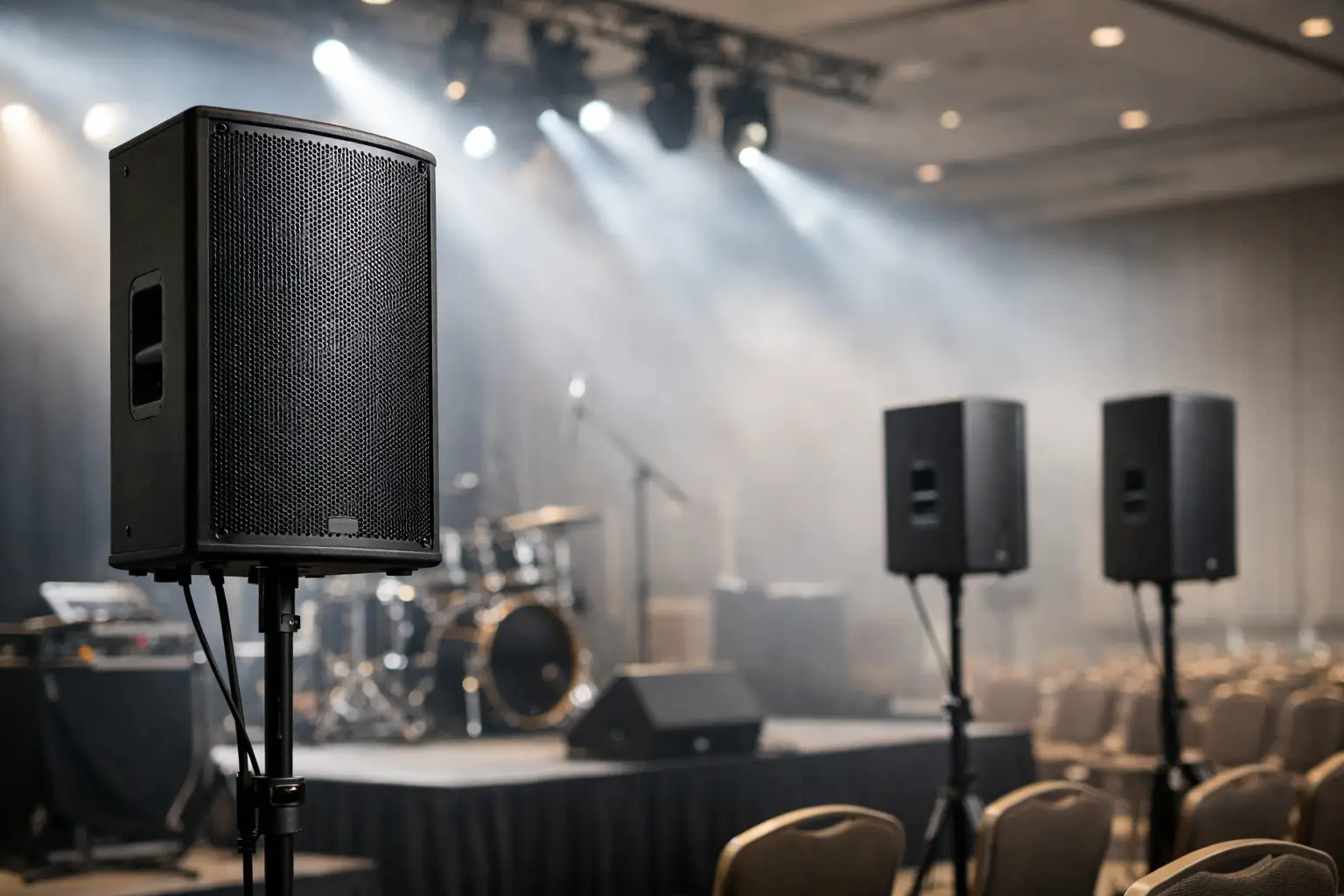
Outdoor Concert Sound Guide for Better Coverage
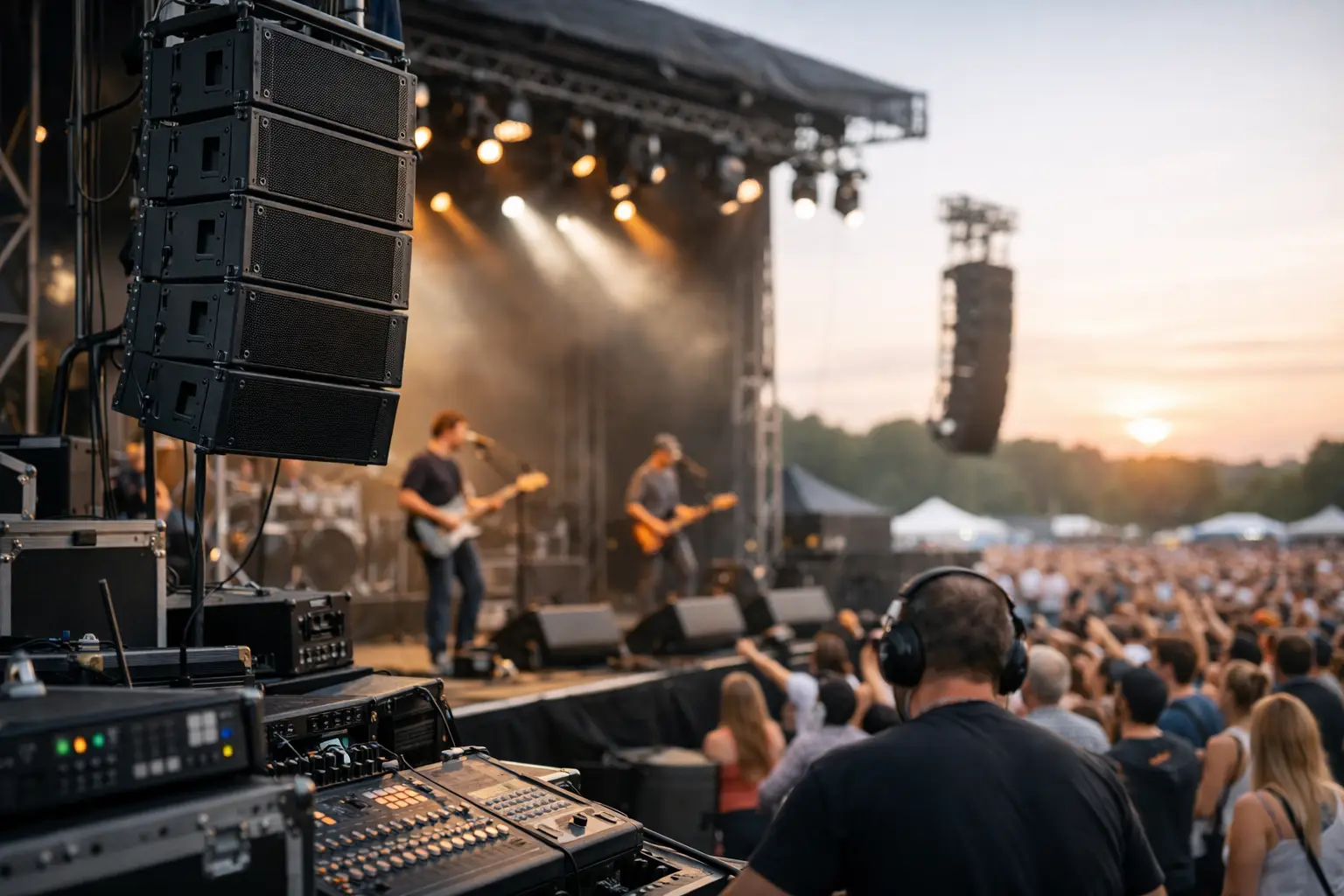
A field can swallow sound faster than most first-time organizers expect. In a ballroom, walls and ceilings help reinforce the system. Outside, that support disappears, wind starts to matter, and the distance between the stage and the last row becomes a real production problem. That is why an outdoor concert sound guide matters early in planning, not the week of the show.
If you are producing a festival set, community concert, corporate outdoor event, or wedding with live music, the goal is simple to say and harder to execute – clear, even sound for the audience without turning the stage into a fight. Getting there takes more than renting a few speakers. It takes coverage planning, proper system sizing, power coordination, and a crew that understands how outdoor environments behave.
What makes outdoor concert audio different
Outdoor sound is less forgiving because there is nothing containing it. Indoors, reflections can sometimes help music feel bigger, even if they also create their own issues. Outdoors, the system has to do almost all the work itself. If the speakers are undersized, poorly aimed, or too far apart, the audience hears it immediately.
Distance is the first major factor. Sound pressure drops as listeners move farther from the source, so a mix that feels strong at front of house can thin out halfway back if the system design does not account for throw. The second factor is wind and weather. Wind can push high frequencies off axis, and temperature shifts can slightly change how sound travels across a large audience area. You do not need to overcomplicate this, but you do need to respect it.
Stage volume is another outdoor issue that gets overlooked. Guitar amps, drum kits, side fills, and wedges can build up enough energy on stage that the front-of-house engineer ends up mixing around the noise instead of shaping a controlled result. In outdoor settings, clean input and controlled stage volume often make a bigger difference than simply asking for more PA.
Outdoor concert sound guide: start with audience coverage
The best place to begin is not with a speaker brand or wattage number. It is with the audience area. How many people are attending, how wide is the listening zone, how deep does it run, and will guests be standing, seated, or moving between activations? Those answers shape the system.
A small audience spread across a very wide lawn may need a different approach than a dense crowd packed in front of a stage. Likewise, a 300-person acoustic concert can require more thoughtful coverage than a louder 1,000-person DJ set if the expectation is pristine vocal clarity. The point is that crowd count alone does not tell you what to deploy.
Speaker placement matters just as much as speaker quantity. Many outdoor shows benefit from a left-right main PA, but once the audience area becomes deeper or wider, delay speakers or front fills may be needed to keep coverage even. Without them, guests in the front rows can get blasted while guests farther back struggle to make out vocals.
There is also a trade-off. More boxes can improve consistency, but they also add rigging, cabling, tuning time, and budget. A good production partner helps you decide where added system complexity genuinely improves the experience and where it is just excess.
Choosing the right PA size
There is no universal formula that says a certain crowd size always needs a certain system. Music style, audience expectations, site layout, local noise limits, and stage orientation all matter. Still, there are practical ranges.
A compact powered speaker package may cover a ceremony lawn, small courtyard concert, or intimate private event. A midsize line array or point-source system with subs can handle many community events, outdoor corporate shows, and midscale concerts. Larger festival-style events usually require a more advanced main system, sub deployment strategy, delay towers, and experienced tuning.
Subwoofers deserve special attention. They are not only about making the show louder. Proper low-end support gives music weight and helps the mix feel complete. But too much sub outdoors can create a muddy or uneven audience experience, especially if placement is an afterthought. Low frequencies interact across space in ways that can produce hot spots and dead zones. Good deployment fixes that before guests arrive.
The stage matters more than people think
An outdoor concert is not just a PA on sticks in a parking lot. The stage layout directly affects sound quality. Monitor world, backline placement, mic selection, drum shielding when needed, and even how risers are positioned all influence what the audience hears.
If performers cannot hear themselves well, they ask for more level in the monitors. That extra stage volume bleeds into vocal mics, competes with the PA, and reduces clarity. For some events, in-ear monitors solve a lot. For others, wedges are still the practical choice. The right call depends on the artist, budget, changeover schedule, and crew support.
This is also where experienced staffing pays off. Fast, organized patching and stage management keep changeovers tight and reduce the risk of last-minute audio issues. For multi-act outdoor events, efficient stage workflow is not a nice extra. It is part of how you protect the audience experience.
Power, noise restrictions, and site logistics
Audio planning often gets treated as separate from site planning, but outdoor shows do not work that way. Your system is only as reliable as the power behind it. Clean, adequate power distribution is essential for consoles, amplifiers, wireless systems, backline, and stage support equipment.
Generator power may be necessary for parks, remote venues, or temporary festival grounds. When that is the case, audio, lighting, and video loads need to be coordinated instead of guessed. Underpowered or poorly managed distribution leads to noise, instability, or shutdowns, and none of those problems are cheap on show day.
Local noise ordinances matter too. Many outdoor venues and municipalities have curfews or SPL limits. Those rules should inform the system design from the start. If your site has strict restrictions, the answer is not always a smaller show. Sometimes it means better speaker control, tighter coverage, and smarter system tuning so more energy stays on the audience and less spills into surrounding areas.
Don’t overlook the mix position
Front of house should be where the audience experience can actually be judged. That sounds obvious, but outdoor events sometimes compromise this to save space or satisfy layout requests. When the engineer is off to the side, under a tent too far back, or blocked from hearing the mains accurately, the mix suffers.
A strong system still needs a skilled operator in a usable position. This is especially true for events with multiple presenters, live bands, playback, guest speeches, or quick transitions. Good equipment does not replace active mixing. It gives the engineer the tools to keep the event controlled and musical.
Outdoor concert sound guide for budgets that need to make sense
Most clients are balancing quality against budget, and that is a reasonable place to be. The key is knowing where to cut carefully and where cutting creates risk. Reducing unnecessary inventory is smart. Undersizing the PA, skipping technical labor, or ignoring power planning usually costs more later.
A practical budget starts with priorities. If speech intelligibility is critical, make sure coverage and vocal clarity lead the conversation. If the event is music-forward, low-end support and experienced mixing matter more. If the site is large and exposed, spend on system design before decorative extras.
This is where a single production partner can simplify the process. Instead of managing separate sound, stage, lighting, and power vendors, you get one team aligning the technical plan. For many West Coast events, especially outdoor productions with tight install windows or city coordination, that accountability saves time and reduces surprises.
When to bring in full production support
Some outdoor concerts can be handled with straightforward audio rental and an experienced onsite tech. Others need broader production management. If your event includes permits, staging, lighting, LED walls, multiple performers, broadcast elements, or a complex load-in, the audio plan should not live in isolation.
That is often the point where full-service support becomes the better value. A coordinated team can align stage dimensions, power distribution, patching, crew scheduling, and show flow from the beginning. Companies like GeoEvent often step in here not just to provide gear, but to make sure the sound system fits the event around it.
The best outcome is not the loudest show. It is an audience that hears every word and every song clearly, a stage team that can work without friction, and an organizer who is not solving technical problems during doors. Outdoor concerts have enough moving parts already. Sound should be one of the areas you can trust.