How to Staff Live Events Without Show-Day Gaps
A beautiful stage, premium AV equipment, and a strong run of show can still fall apart if the right people are not in the right positions. Knowing how to staff live events is about more than filling shifts. It means building a crew that can load in safely, solve problems quickly, support presenters and performers, and keep the guest experience polished from doors open through teardown.
For a corporate conference, wedding, concert, festival, or trade show, staffing should be planned alongside the technical design. The crew structure needs to reflect the event’s scope, venue conditions, schedule, equipment package, and level of live risk. A simple daytime meeting may need a compact, experienced team. A multi-stage festival needs clear department leadership, shift coverage, and a stronger contingency plan.
Start With the Event, Not a Headcount
The most common staffing mistake is choosing a crew size before defining what the event actually requires. Two events with the same guest count can need very different support. A 300-person dinner with speeches and a DJ has a different technical workload than a 300-person product launch with video playback, walk-on music, multiple presenters, LED walls, and a live stream.
Start with the show flow. Identify every technical and operational moment that must happen on cue: load-in, rigging, stage build, soundcheck, rehearsals, doors, presentations, entertainment, room turns, strikes, and load-out. Then map the people responsible for each task.
Also consider the venue. Ballroom access, loading dock distance, ceiling height, power availability, union requirements, parking, elevator access, curfews, and neighborhood noise restrictions can all affect crew size and call times. A smaller crew may be budget-friendly on paper, but it can become expensive when setup falls behind or a rushed team makes preventable mistakes.
Define Essential Roles Before Hiring Crew
Every live event benefits from a clear chain of responsibility. On smaller programs, one skilled technician may cover more than one area. On larger or more complex shows, separating responsibilities protects both timing and quality.
Production Lead or Show Caller
This person owns the overall execution plan. They coordinate the client, venue, vendors, and technical departments; manage the schedule; confirm changes; and make decisions when conditions shift. During the show, they may call cues or work closely with the person who does.
For events with many moving parts, such as conferences with frequent speaker transitions or concerts with multiple acts, a dedicated production lead prevents technical operators from being pulled into client communication at the wrong moment.
Audio Team
Audio staffing depends on the number of microphones, presenters, performers, playback sources, rooms, and recording or streaming requirements. A basic speaking program may need one audio engineer. A band, multiple wireless microphone channels, monitors, and a high-pressure show schedule may require a front-of-house engineer, monitor engineer, and audio technician.
Do not assume a sound engineer can also manage lighting, stage changes, and client requests. When the room fills, audio deserves focused attention.
Lighting and Video Operators
Lighting operators handle programmed looks, transitions, specials, and live adjustments that keep a room or stage visually intentional. Video operators may manage presentation playback, camera feeds, confidence monitors, LED video walls, switching, and content changes.
If a presenter’s slides, walk-on video, or camera feed is central to the program, assign a qualified person to that system. Asking a single operator to run both a complex lighting show and presentation playback can create unnecessary exposure during cue-heavy moments.
Stagehands and General Technicians
Stagehands and utility technicians support physical work: unloading equipment, building staging, placing pipe and drape, running cable, changing furniture, moving backline, and assisting with strikes. Their value is especially clear during tight load-ins and fast room turns.
The right number depends on access and weight, not just event size. A ground-floor venue with a nearby dock may move quickly with a leaner team. A rooftop event with freight elevator limits needs more labor and more time.
Guest-Facing Support
Technical staffing is only part of the plan. Depending on the event, you may also need stage managers, presenters’ assistants, registration support, ushers, security, talent runners, or venue attendants. These roles keep presenters, guests, and performers from turning to an audio engineer or lighting operator for help during critical cues.
Build Call Times Around Reality
Call times should be based on the work required, not the published event start time. A 6:00 p.m. reception might require crew on site at 8:00 a.m. if the room needs staging, lighting, video, sound, décor coordination, and a rehearsal.
Build the schedule backward from the first non-negotiable moment, then add time for testing and correction. Equipment must be unloaded, installed, powered, patched, tested, tuned, and rehearsed before the audience enters. Plan time for client walk-throughs, content updates, soundchecks, vendor arrivals, and the small issues that always appear on site.
A useful schedule includes separate milestones for crew call, load-in complete, technical build complete, line check, system test, rehearsal, doors, show start, show end, strike, and load-out. If a milestone has no owner, it is likely to slip.
Avoid cutting setup time simply to reduce labor hours. The better budget decision is often to staff a focused load-in adequately, complete the work safely, and avoid paying for last-minute corrections or overtime later.
Match Experience to the Risk Level
Not every position needs the same level of seniority. A capable utility technician can handle cable management, equipment movement, and general setup under department supervision. But show calling, wireless microphone coordination, power distribution, rigging oversight, live video switching, and lead audio mixing require experienced professionals.
The right mix is usually a lead technician or department head supported by qualified crew. This structure is more cost-conscious than overstaffing every position with senior operators, while giving the event a clear source of expertise when a decision is needed.
Experience also matters because live events are rarely static. A skilled crew member recognizes a potential failure before it affects the room: a weak wireless signal, a misplaced confidence monitor, a delayed speaker, a loud HVAC system, or an unsafe cable path. That judgment is difficult to replace with a long equipment list.
Plan Coverage, Breaks, and Backups
Staffing is not complete when every role is assigned. Ask who covers each key position if a crew member is on a meal break, helping with an emergency, or pulled into another area. This is particularly important for long show days, festivals, multi-room conferences, and events with overlapping programming.
For critical systems, create practical redundancy. That can mean spare wireless microphones, backup playback, duplicate presentation files, extra power and data cable, replacement lamps or fixtures where appropriate, and a technician who understands the signal path. A backup system without someone who can deploy it is only partial protection.
Be realistic about labor rules and fatigue. Long shifts, late-night strikes, heat, outdoor work, and repetitive lifting affect safety and performance. Scheduling enough qualified coverage protects the crew and the client’s timeline.
Communicate Roles Before Load-In
A crew is strongest when everyone knows the plan before arriving at the venue. Send a concise production brief with the schedule, load-in instructions, venue contacts, parking details, equipment scope, floor plan, stage plot, power plan, show flow, dress expectations, and escalation contacts.
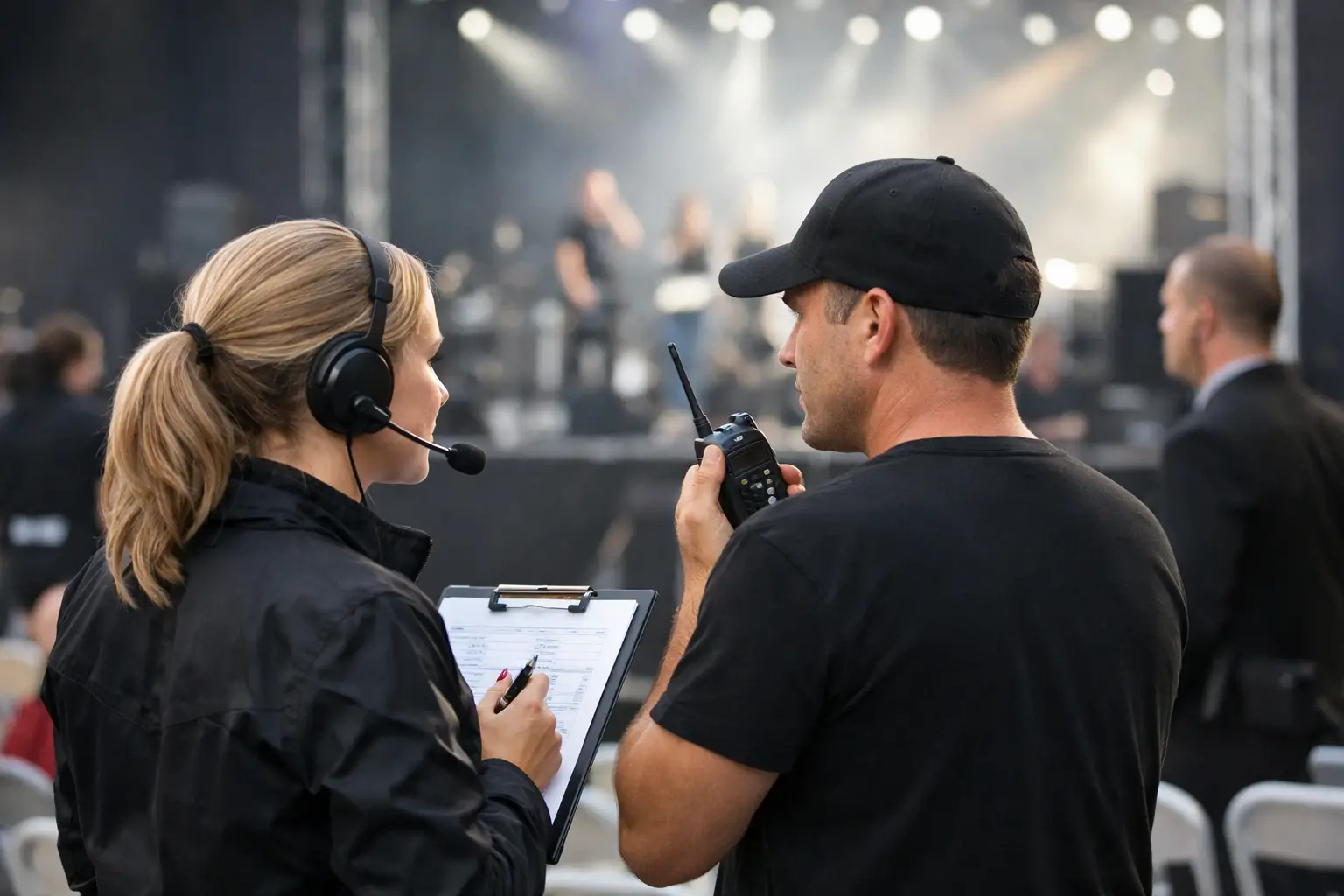
At crew call, hold a short briefing. Confirm the day’s priorities, safety expectations, department leads, communication channels, and any schedule changes. For larger events, radio assignments and clear language for cueing are worth establishing early.
The goal is not to over-meet. It is to prevent technicians from working from different assumptions. When a client changes a presentation order or adds a last-minute microphone, the production lead should communicate that change to every affected department rather than relying on informal handoffs.
Choose One Accountable Production Partner
Coordinating separate AV rental, labor, staging, lighting, and video vendors can work, but it places more responsibility on the event organizer to align schedules, scope, and accountability. For events with multiple technical elements, a full-service production partner can simplify staffing because the equipment plan and crew plan are built together.
GeoEvent supports clients with both rental equipment and on-site production staffing, so the crew understands the systems they are installing and operating. That continuity helps reduce handoff issues from planning through teardown, whether the event is in Los Angeles, San Diego, San Francisco, Las Vegas, or elsewhere on the West Coast.
The best staffing plan gives every important moment a capable owner. When the crew has clear roles, adequate time, and the authority to solve problems, guests notice what they should notice: a confident, well-run event.