How to Rent Event Audio Gear Without Mistakes
A packed room can forgive a short line at check-in. It will not forgive bad sound. If guests cannot hear the vows, the keynote, or the band, the whole event feels off. That is why knowing how to rent event audio gear matters long before load-in day.
The right rental plan is not just about getting speakers and microphones on site. It is about matching the system to the room, the crowd, the program, and the people operating it. Some events only need a straightforward pickup-and-return rental. Others need delivery, setup, tuning, live mixing, and teardown from a crew that can keep the show moving if something changes.
How to rent event audio gear starts with the event itself
Before you request a quote, get clear on what the sound system needs to do. A wedding ceremony, a general session, a DJ-driven party, and a multi-stage festival can all be called events, but their audio needs are very different.
Start with the format. Ask whether you need speech reinforcement, music playback, live band support, panel microphones, audience Q and A, or all of the above. Speech-first events usually need clarity and even coverage more than sheer volume. Music-heavy events need more low end, more headroom, and more control at the mixing position.
Then look at the venue. Indoor ballrooms behave differently than outdoor courtyards. High ceilings, reflective walls, wind, and distance all affect how much system you need and how it should be deployed. A system that works in a small conference room may struggle in a warehouse or open-air venue.
Guest count matters too, but it is not the only factor. Two hundred people seated classroom-style is not the same as two hundred people spread through a cocktail layout. The wider the audience area, the more intentional the speaker placement needs to be.
Know the core pieces of event audio gear
If you are not an audio engineer, rental terminology can feel more technical than it needs to be. In practice, most event audio packages are built from a few core categories.
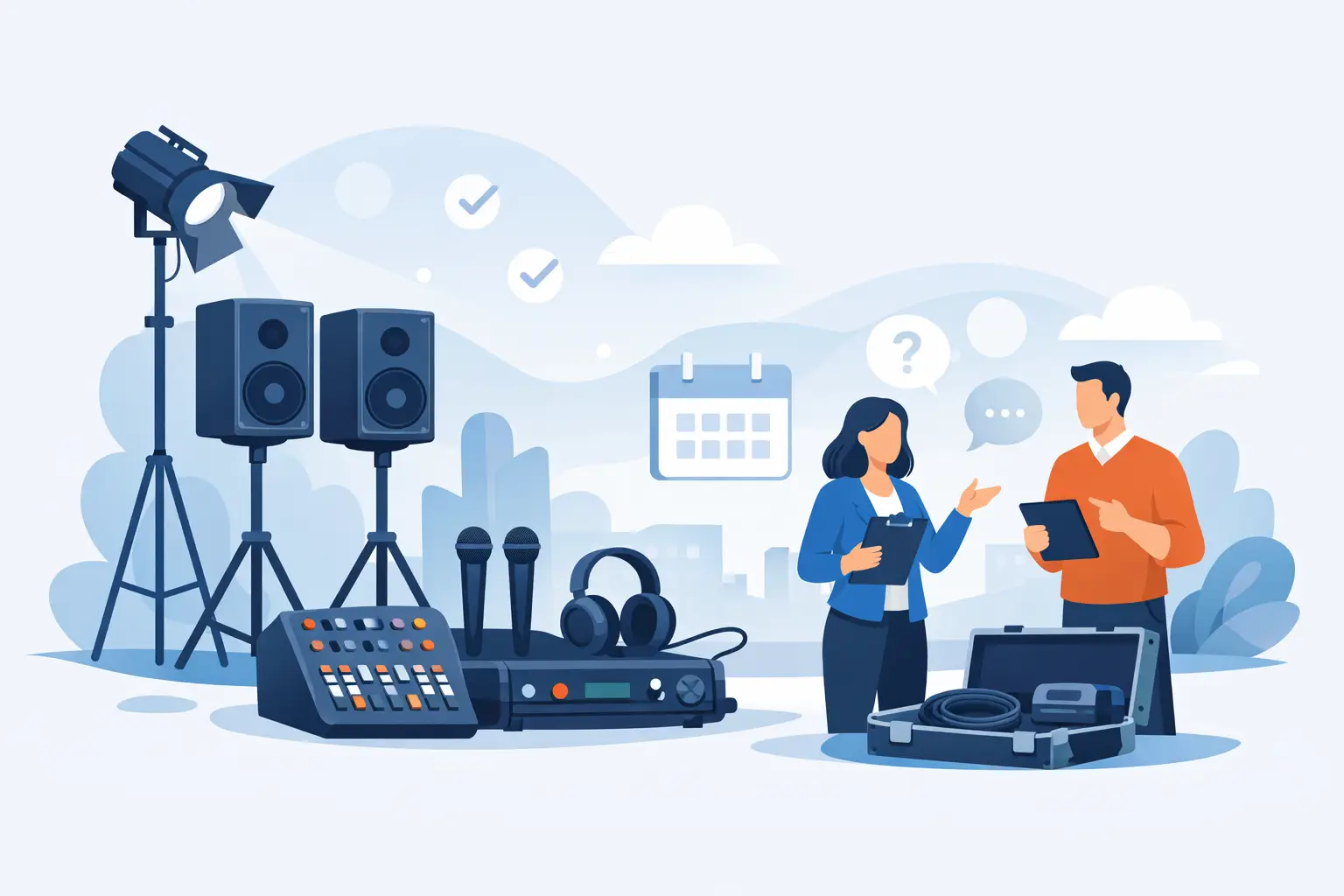
Speakers are the main output. Depending on the event, you may need powered speakers, subwoofers, front fills, stage monitors, or delay speakers for larger spaces. Microphones can include handheld wireless, lavaliers, headset mics, podium mics, and wired vocal mics. Mixers are the control center, whether that is a small analog board for a simple meeting or a digital console for a complex live show.
You may also need DI boxes for laptops or instruments, playback devices, speaker stands, cables, power distribution, and comms for crew coordination. None of these items are exciting on their own, but they are often the difference between a clean setup and a stressful one.
This is where a good rental partner adds real value. They should not just hand over inventory. They should ask enough questions to build a package that actually works together.
Right-size the system instead of renting by guesswork
One of the most common mistakes is renting too little gear to save money, then paying for it in poor coverage or feedback problems. The other is overbuilding the system and spending budget on volume you do not need.
The right package depends on coverage, not just power. A small wedding ceremony might only need two speakers, a wireless mic, and a simple playback connection. A corporate breakout may need multiple wireless lavaliers, a small mixer, confidence monitors, and a technician to manage transitions. A live performance may require mains, subs, wedges or in-ear support, a monitor mix, and more input channels than expected.
If your event has multiple spaces, think through each one separately. The lobby, the main room, the ceremony site, and the after-party may all need audio support. That is often where planners get surprised. They budget for the headline room and forget the rest of the guest experience.
Decide whether you need rental only or full support
This is the biggest fork in the road when figuring out how to rent event audio gear. Some clients have an experienced in-house tech, a touring engineer, or a venue team that can run the system. In that case, equipment-only rental can make perfect sense.
But if no one on your team is comfortable patching microphones, ringing out speakers, managing wireless frequencies, and adjusting levels live, rental alone can become risky fast. Even a simple event has moving parts. A presenter swaps from a lav to a handheld. A DJ arrives with a different output than expected. A band adds an instrument. A room fills up and changes the acoustics.
That is where delivery, setup, on-site operation, and teardown are worth serious consideration. You are not only paying for gear. You are paying for accountability. If the event matters, having a professional crew responsible for sound often protects both the schedule and the experience.
Ask better questions before you book
A rental quote should be easy to read and specific enough that you know what is included. If it is vague, ask for detail. You want to know the exact type of microphones, speakers, mixer, stands, and accessories included, along with delivery timing, setup windows, pickup, and support options.
Ask who is responsible for load-in and strike. Ask whether the system is designed for your venue size and program type. Ask what happens if there is a problem during the event and whether on-call or on-site support is available. If wireless microphones are involved, ask how frequency coordination will be handled, especially in dense urban markets or convention environments.
It is also smart to ask what is not included. Power drops, cable ramps, staffing, staging, podiums, and playback laptops are often assumed by one side and omitted by the other. Clear scope early saves money later.
Budget smart without cutting the wrong corners
Most clients are balancing production quality against a fixed budget. That is normal. The goal is not to spend the most. It is to spend where sound quality and reliability actually affect the event.
If budget is tight, prioritize speech intelligibility, enough microphones for the agenda, and proper setup time. Those items usually matter more than adding extra output you will never use. For music-driven events, low end and system tuning may deserve more budget than cosmetic add-ons.
Be realistic about labor. Self-managing setup can look cheaper on paper, but labor costs often reappear as delays, troubleshooting, or last-minute fixes. A vendor that helps you scale the package to the event, rather than upselling by default, is usually the better long-term partner.
Venue rules and logistics can change the quote
Audio rentals are not chosen in a vacuum. Loading dock access, elevator size, union rules, curfews, power availability, and setup windows all affect the plan. Outdoor events add weather protection, longer cable runs, and backup thinking.
This matters especially in busy event markets like Los Angeles, San Diego, San Francisco, and Las Vegas, where venue logistics can be tight and event calendars move fast. A system that is simple on paper can become more labor-intensive if access is restricted or setup time is compressed.
If your venue already has in-house sound, do not assume it covers everything. Sometimes the installed system is great for background music but weak for live performance. Sometimes it works well in one room and not another. Ask for the house AV spec early, then compare it against your program needs before deciding what to rent.
How to rent event audio gear for different event types
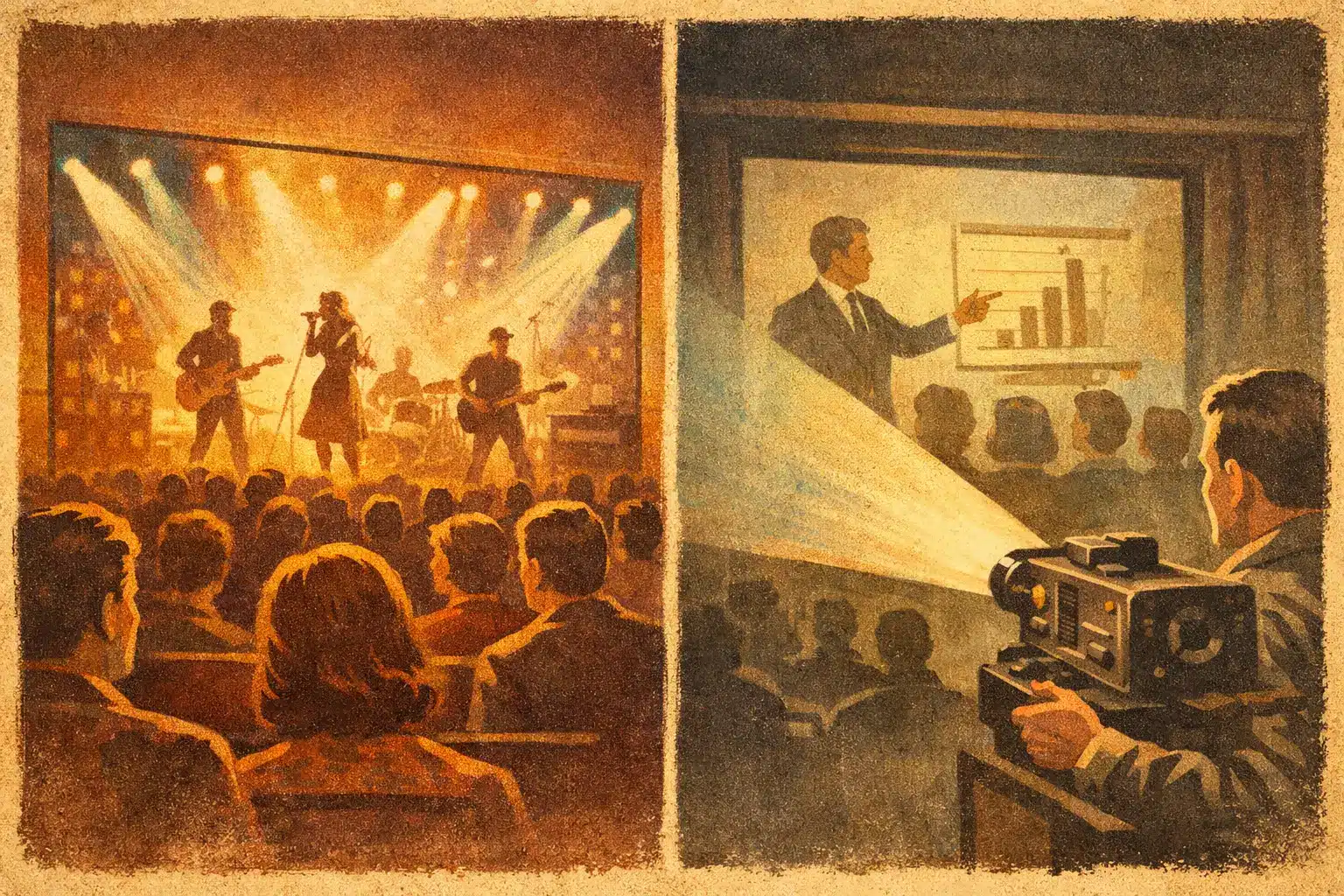
Not every event should be approached the same way. A wedding usually needs discreet, reliable coverage for ceremony, toasts, and reception moments, with fast transitions between spaces. A conference often needs clean speech reinforcement, multiple wireless channels, playback support, and dependable technician coverage throughout the day.
Festivals and concerts require a different level of planning. Input lists, stage plots, monitor needs, changeovers, and system output all become more demanding. Trade shows can be deceptively complex too, especially when multiple booths or demo zones compete for attention in the same hall.
The common thread is that event audio should be built around the run of show. If your vendor understands the schedule, they can recommend gear and staffing more accurately.
Choose a partner, not just a price
Price matters, but event audio is one of those categories where the cheapest line item can become the most expensive mistake. A good rental company should be responsive, technically credible, and honest about trade-offs. They should tell you when a smaller package is enough and when added support is worth it.
That is especially valuable if you are coordinating audio alongside lighting, staging, projection, or LED walls. Working with one accountable production partner can reduce handoff problems and simplify communication across the entire event. For many clients, that operational clarity is just as important as the equipment itself.
If you are weighing options, pay attention to how the conversation feels. Are they asking useful questions? Are they pressure-testing your assumptions? Are they thinking through setup, show flow, and teardown, not just the rental dates? That is usually a sign you are dealing with a team that understands live events in the real world.
The best audio rental is the one nobody notices because every cue lands, every word is clear, and your team can focus on the event instead of the sound system.