Best Outdoor Event Sound Solutions That Work
A backyard wedding with 120 guests and a coastal festival with 3,000 attendees can both be called outdoor events, but the sound plan for each is completely different. That is why finding the best outdoor event sound solutions starts with one simple question: what does your audience actually need to hear, and from where?
Outdoor audio is less forgiving than indoor sound. There are no walls to contain energy, no ceiling to help reflect speech, and no room acoustics to smooth over weak coverage. If the system is undersized, guests in the back miss every announcement. If it is oversized or poorly aimed, the front rows get blasted while nearby neighbors get the rest. Good outdoor sound is not just about volume. It is about coverage, clarity, control, and having a crew that can adjust when conditions change.
What the best outdoor event sound solutions actually solve
The biggest mistake in outdoor production is treating speakers like a commodity. Clients often ask for a speaker count before anyone has mapped the venue, confirmed power, or looked at the run of show. In practice, the best outdoor event sound solutions solve a group of operational problems at once.
First, they create even coverage across the audience area. A good system should let guests near the stage and guests at the perimeter hear the same message with roughly the same clarity. That usually means thinking in zones, not just dropping two loudspeakers at the front and hoping for the best.
Second, they match the content. Speech-heavy events such as corporate presentations, ceremonies, fundraisers, and community announcements need strong vocal intelligibility. Music-driven events need more low-end support, more headroom, and better system tuning. A wedding ceremony on a lawn does not need the same subwoofer package as a DJ set or live band.
Third, they account for the site. Wind, open-air layouts, hard surfaces, tenting, stage placement, and audience depth all affect performance. A beachside event can sound very different from a courtyard, parking lot, or vineyard. The right system is always tied to the environment.
Start with event type, not equipment lists
When planners search for audio rentals, it is easy to focus on brand names and wattage. Those details matter, but they matter less than the event format.
Weddings and private celebrations
For outdoor weddings, the priority is usually clean, consistent speech during the ceremony and smooth transitions into cocktail hour and reception. Wireless microphones, discreet speaker placement, and separate zones are often more valuable than sheer output. You may need one setup for vows, another for dinner, and a stronger system for dancing later. Trying to make one small rig cover every phase of the day often creates compromises.
Festivals and concerts
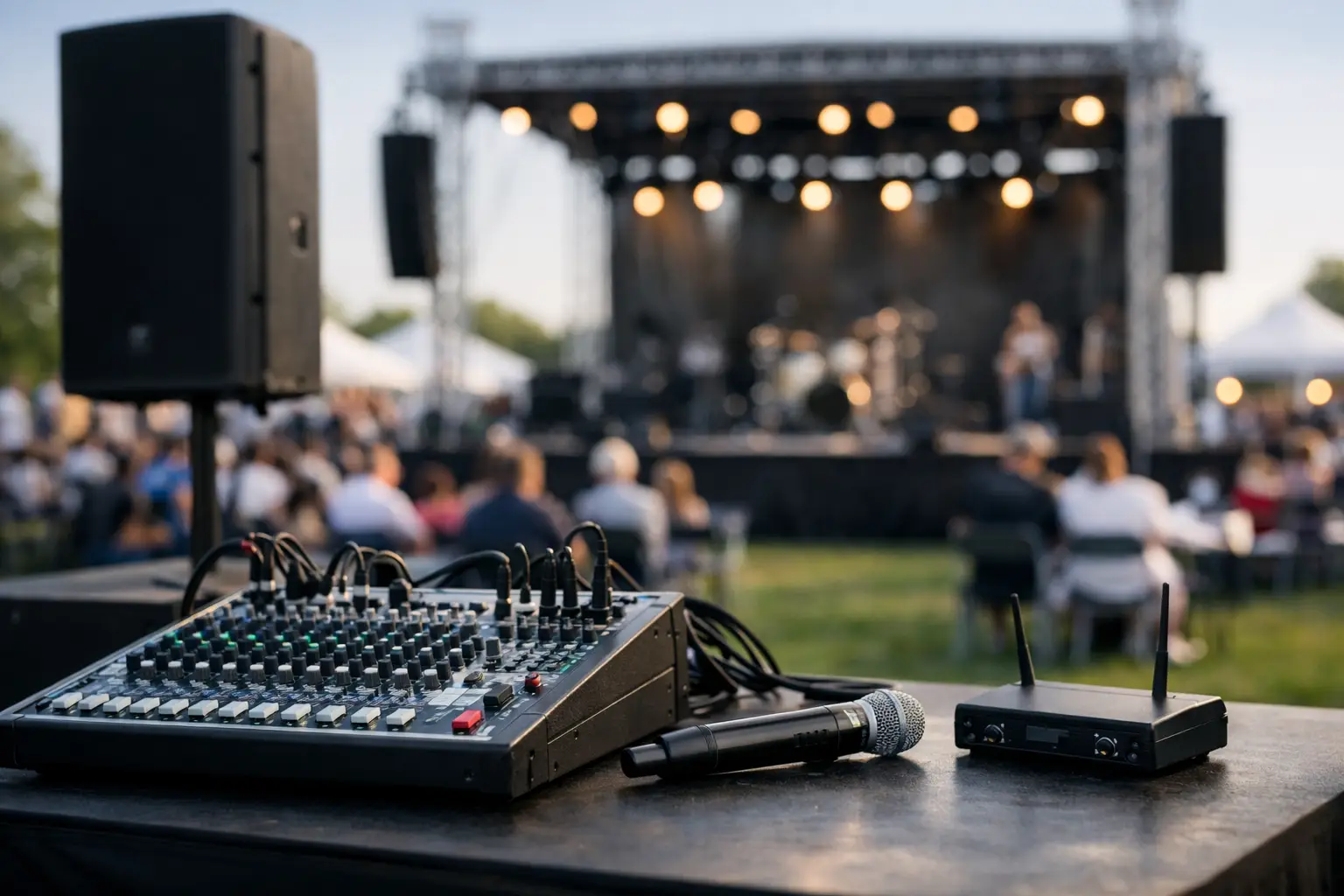
Live music outdoors requires more planning and more control. Audience size, stage plot, artist input, monitor needs, and local sound limits all come into play. In these settings, line array systems, subwoofer deployment, front fills, delay speakers, and a properly staffed front-of-house position can make the difference between a professional experience and a muddy one. This is also where setup time and system tuning become non-negotiable.
Corporate events and public programs
Corporate presentations, trade show activations, campus events, and civic gatherings usually rise or fall on intelligibility. If attendees cannot clearly hear presenters, panelists, or video playback, the entire event loses impact. These events benefit from distributed coverage, dependable wireless coordination, and redundancy for playback and presentation audio.
Coverage matters more than raw volume
A common planning mistake is assuming louder means better. Outdoors, louder often just means less comfortable for people nearest the speakers while everyone farther back still struggles.
The better approach is to design for coverage. That may include main speakers at the stage, delay speakers for deeper audience areas, and carefully angled fills for zones that mains miss. For spoken-word events, this keeps announcements understandable without overdriving the system. For music events, it helps maintain energy across the full audience area instead of creating hot spots and dead zones.
Speaker placement is just as important as speaker choice. Height, angle, and distance all affect how well a system performs. A properly aimed system can often outperform a larger but poorly positioned one. That is one reason experienced planning and on-site tuning save money as often as they improve quality.
The right microphones and mixing setup are part of the solution
When people think about outdoor sound, they usually picture speakers first. In reality, microphones and mixing are where many failures begin.
Wireless systems need clean frequency coordination, especially in busy metro areas or at events with multiple vendors on site. Handheld microphones may work well for emcees and toasts, while headset or lavalier microphones are often better for officiants, presenters, and panel discussions. The right choice depends on movement, wardrobe, and how visible the microphone can be.
Mixing also changes by event type. A DJ-focused event may need playback management and strong low-end control. A live band needs input planning, monitor mixes, and room for dynamic changes. A corporate program may need playback, podium mics, panel mics, video feeds, and remote presenter support. Good engineering is not an add-on. It is part of the sound solution.
Power, weather, and logistics can make or break outdoor audio
The best system on paper still fails if the site cannot support it. Outdoor events need realistic planning around power distribution, cable paths, load-in access, weather protection, and setup windows.
Power is a frequent issue. Smaller events may be fine on venue circuits, but larger systems, backline, lighting, LED walls, and catering equipment can quickly compete for available power. If the audio system shares unstable or overloaded circuits, you risk noise, shutdowns, or worse. Confirming power early avoids last-minute scrambling.
Weather is the other big variable. Wind affects coverage and microphone performance. Heat impacts equipment and crew comfort. Unexpected moisture changes everything. Outdoor production needs contingency planning, protective placement, and enough labor to adapt quickly. If your provider talks only about gear and not about operations, that is usually a warning sign.
Rental-only versus full-service production
For some events, renting speakers and microphones is enough. If you have an experienced in-house team, a simple site, and a straightforward run of show, standalone audio rental can be the most cost-effective route.
But many outdoor events are not simple. They involve multiple program segments, schedule changes, vendor coordination, permits, staging, lighting, video, and live audience pressure. In those cases, a full-service partner often costs less than piecing together separate vendors and managing the risk yourself. One accountable team can plan the system, coordinate logistics, provide crew, handle setup and teardown, and run the show live.
That is especially valuable for first-time planners and for teams already balancing venue, catering, talent, and guest experience. It also helps experienced producers who need a regional partner that can execute reliably in markets like Los Angeles, San Diego, San Francisco, or Las Vegas.
How to choose among the best outdoor event sound solutions
The strongest proposals usually sound practical, not flashy. They ask for site maps, audience counts, run of show details, and power information. They explain why a system is sized a certain way. They mention trade-offs. They account for weather, speech intelligibility, monitoring, and staffing.
Be cautious with one-size-fits-all packages. Outdoor audio is rarely that simple. A vendor should be able to tell you whether your event needs distributed coverage, delay speakers, a dedicated monitor console, backup microphones, or a separate ceremony and reception system. If they cannot explain the reasoning, the setup may be built for convenience rather than performance.
It also helps to choose a partner that can support more than just audio if needed. Outdoor events often evolve. A client who starts with speaker rental may later need staging, lighting, LED walls, projectors, labor, or full production support. Working with one team reduces handoff issues and keeps decision-making clear. That is part of why GeoEvent approaches outdoor production as an execution problem, not just an equipment order.
Budget decisions that are worth making carefully
Every event has budget pressure, and audio is often expected to do a lot with limited resources. The smart move is not always spending more. It is spending in the right places.
If the event is speech-driven, prioritize coverage, microphone quality, and an operator who can manage cues and levels. If it is music-driven, prioritize headroom, sub support, and proper deployment. If the site is large or irregular, invest in system design before adding extra boxes. If the schedule is tight, invest in crew.
Cutting the wrong line item usually costs more later. A slightly smaller stage package or simpler lighting design may be manageable. An underbuilt sound system is much harder to hide once guests arrive.
Outdoor events ask more from sound than most people realize. There is more air to cover, more variables to manage, and less room for error. The best results come from matching the system to the audience, the content, and the site – then backing that plan with people who know how to execute under pressure. When that part is handled well, everything else on the schedule has a better chance to land the way you intended.