Speaker Coverage Calculation for Event Audio
A speaker that sounds excellent at front-of-house can still leave half the room struggling to hear. That is why speaker coverage calculation is not simply a matter of choosing bigger boxes or adding more volume. It is the process of matching loudspeaker dispersion, placement, room geometry, audience size, and program material so every guest receives intelligible, comfortable sound.
For a corporate presenter, the priority is clear speech in every seat. For a concert or festival, the system also needs impact, musical balance, and enough headroom to stay clean at show level. A wedding may need even coverage without overwhelming guests near the dance floor. The right approach changes with the event, but the planning principle is the same: design sound around the audience area, not around a list of available equipment.
Start With the Audience Area, Not the Speaker
Before selecting a PA system, define where people will actually be listening. Measure the width and depth of the seating or standing area, note the ceiling height, identify stage location, and mark areas that may be blocked by balconies, pillars, video walls, tents, or décor. A room’s usable audience area is rarely a perfect rectangle.
For outdoor events, the boundaries can be more flexible, but distance and environmental noise become bigger factors. A festival audience may spread wider as the day progresses. Traffic, generators, nearby stages, wind, and open-air sound loss all affect how much output and control the system needs.
The goal is not necessarily to cover every square foot of a venue. It is to cover the areas where guests need to hear with the appropriate level and clarity. This distinction prevents wasted equipment, excessive spill, and avoidable budget pressure.
Identify the critical listening positions
A practical system design starts by checking three positions: the closest audience member, the center of the audience, and the farthest intended listener. If the front rows are painfully loud while the rear seats are weak, the system is not evenly designed, even if the speakers are powerful enough on paper.
Also consider side seating. Wide rooms often create a common problem: speakers aimed to reach the far left and right edges may send too much energy onto hard side walls. That reflected sound can reduce speech intelligibility and make music feel harsh. In those cases, narrower coverage speakers, additional delay positions, or carefully placed front fills may perform better than one wide, high-output system.
The Basic Speaker Coverage Calculation
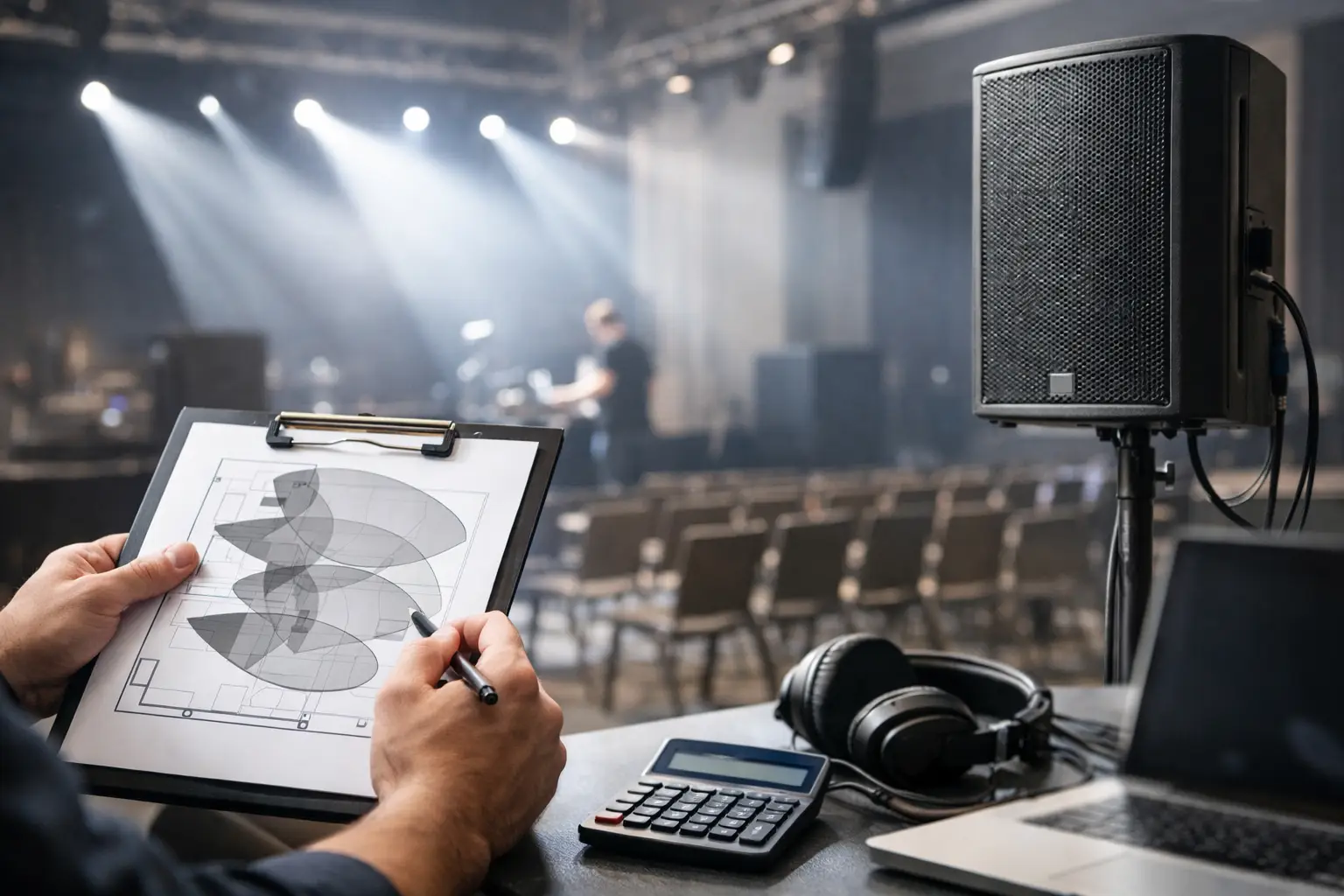
Every loudspeaker has a stated dispersion pattern, commonly expressed as horizontal by vertical coverage. A speaker listed as 90 degrees by 60 degrees, for example, is designed to distribute sound across an approximate 90-degree horizontal and 60-degree vertical angle. Those numbers are a starting point, not a guarantee that every point in the pattern will sound identical.
To estimate the width covered by a speaker at a given distance, use this formula:
Coverage width = 2 × distance × tan(coverage angle ÷ 2)
If a speaker has a 90-degree horizontal coverage angle and the audience is 20 feet away, the estimated width is:
2 × 20 × tan(45 degrees) = 40 feet
That tells you the approximate width at the edge of the speaker’s nominal pattern. In real event production, it is wise not to design to the absolute edge. Sound level and tonal consistency usually fall off near the boundaries, and venue surfaces can complicate the result. Aiming for useful overlap between adjacent speakers produces more dependable coverage.
Vertical coverage matters just as much. A speaker flown too high may overshoot the front rows or spray sound onto a ceiling. A speaker placed too low may be blocked by the audience. Proper tilt aims the usable vertical pattern at listeners, not at empty space, walls, or the stage roof.
Distance Changes More Than Volume
Sound level drops as distance increases. In open space, the familiar rule of thumb is that sound pressure level falls by roughly 6 dB each time the distance from a point source doubles. A listener 40 feet from a speaker may receive substantially less direct sound than someone 20 feet away.
Rooms do not behave like open fields, however. Reflections can make the rear of a ballroom seem louder than expected while making speech less understandable. Large convention spaces may have long reverberation times, glass, concrete, and other reflective surfaces that create a wash of delayed sound. Outdoors, there are fewer reflections, but there is also less help from the environment.
This is why speaker coverage calculation must include the type of content being amplified. A DJ set can tolerate more level variation than a keynote speaker. A panel discussion with several wireless microphones needs controlled coverage and excellent gain before feedback. A live band may need a system capable of higher output, but it still benefits from clear aiming and disciplined system tuning.
When One Speaker Pair Is Enough and When It Is Not
A pair of properly positioned full-range speakers can work very well for a small meeting, cocktail reception, ceremony, or compact dance floor. The audience is close, the coverage area is limited, and the speakers can be aimed directly at listeners.
As rooms become wider or deeper, adding speakers is often better than forcing the main pair to work beyond their useful range. The options may include front fills for seats close to the stage, out fills for wide audience sections, or delay speakers for distant areas. Each solution has a different purpose.
Front fills provide coverage for guests below the main speakers’ vertical pattern, especially when mains are flown above a stage or LED wall. Out fills cover seating sections outside the main system’s horizontal pattern. Delay speakers reinforce distant listeners, but they must be time-aligned with the main system. If they are not delayed correctly, guests may hear two separate arrivals of the same signal, which can damage clarity rather than improve it.
Adding more speakers is not automatically an upgrade. More sources can create overlap, comb filtering, and inconsistent level if they are placed without a plan. The best design uses the fewest loudspeakers that can deliver the required coverage, headroom, and control.
Placement and Aiming Decide the Result
The same speaker can produce dramatically different results depending on where it is installed. Height, tilt, spacing, and aiming are operational decisions, not finishing touches.
For ground-supported speakers, raise the high-frequency driver above audience head height whenever practical. This improves line of sight and reduces the number of bodies blocking high frequencies. Aim speakers toward the audience, with care to avoid pointing directly at active microphones. A speaker that is physically close to a presenter’s microphone creates a much higher feedback risk than one placed forward and aimed back toward the crowd.
For flown systems, confirm rigging points, trim height, sightlines, and load limits before finalizing the design. The loudspeaker angle should cover the closest and farthest listeners without wasting energy on the ceiling or rear wall. In outdoor settings, the system must also account for wind exposure, weather protection, safe ballast, cable routing, and local noise restrictions.
Use Subwoofers for Impact, Not to Solve Coverage Problems
Subwoofers add low-frequency extension and physical impact, but they do not fix poor midrange and high-frequency coverage. Speech intelligibility lives primarily in the mid and high frequencies, where speaker aiming and direct sound are most important.
Subwoofer placement does affect the room. A center cluster can create more even bass across a wide audience in some situations, while left-right stacks may be more convenient for staging or visual symmetry. Multiple subs can also produce uneven low-frequency zones if they are not processed and positioned intentionally. There is no one placement that fits every event, especially in rooms with challenging acoustics.
For music-driven events, system tuning should balance the mains and subs so the sound feels full without masking vocals or making the room boomy. For conferences and ceremonies, subs may be unnecessary or used lightly. The right choice depends on the program and the client experience, not a standard package.
Why Professional Prediction and On-Site Tuning Matter
Coverage formulas are useful for early planning, but they cannot fully model every room, tent, courtyard, or outdoor site. Professional system design combines calculations with loudspeaker prediction software, venue assessment, and on-site measurement. This process identifies likely weak zones, excessive overlap, reflection risks, and the proper delay timing before guests arrive.
During setup, technicians verify speaker polarity, set crossover points, tune equalization for the space, establish safe operating levels, and walk the listening area. That final walk is essential. A design that looks right in software may need adjustment because of unexpected staging, seated versus standing audience height, crowd density, or a last-minute room change.
For events across Los Angeles, San Diego, San Francisco, and Las Vegas, the variation can be substantial – from reflective hotel ballrooms and exhibit halls to rooftops, beaches, warehouses, and open festival grounds. GeoEvent approaches coverage as part of the complete production plan, coordinating audio placement with staging, lighting, video, power, and guest flow.
A well-calculated system should disappear into the experience. Guests should not be thinking about where the sound is coming from, whether they can hear the presenter, or why one side of the room is louder than the other. They should simply be able to follow the moment they came to share.