LED Wall vs Projector Events: What Wins?
A ballroom with bright chandeliers, floor-to-ceiling windows, and a packed daytime audience will expose a weak visual setup fast. That is where the led wall vs projector events question stops being theoretical and starts affecting sightlines, content clarity, guest engagement, and your budget.
For some events, a projector is still the smart choice. For others, an LED wall is the difference between a polished production and a screen that feels underpowered. The right answer depends on the room, the run of show, the content you plan to display, and how much technical flexibility you need on site.
LED wall vs projector events: the real decision points
The biggest difference is light output. Projectors rely on throwing an image onto a surface, so ambient light works against them. LED walls create their own light, which makes them far easier to see in bright rooms, outdoor environments, expo halls, and general sessions where house lighting cannot be fully controlled.
That does not automatically make LED the best choice for every event. A projector can still look excellent in a dim ballroom, theater, or controlled conference space. If your content is mostly slides, lower-motion graphics, or video that does not require extreme brightness, projection may give you the result you need at a lower cost.
The practical question is not which format is better in general. It is which format performs better in your venue, for your audience, within your budget.
When an LED wall is the stronger choice
LED walls are usually the better fit when visibility is non-negotiable. If guests are seated far from the screen, if the room has natural light, or if the event schedule runs from daytime into evening, LED gives you more consistency. The image holds up better without forcing the venue into near-blackout conditions.
This matters at corporate conferences, trade shows, festivals, product launches, and awards programs where visuals carry the show. Brand colors look stronger, motion graphics feel more dynamic, and cameras generally capture LED screens better for IMAG, recording, and livestream support.
LED walls also give production teams more freedom with staging. You are not locked into the geometry of a projector throw path. There is no concern about presenters walking through the beam, and there is less compromise around rigging positions, scenic pieces, or room layout. If the stage design needs to feel modern and high-impact, LED usually supports that goal more naturally.
There are trade-offs. LED walls cost more than basic projection setups, especially as size, resolution, and support requirements increase. They can also require more planning for power, load-in access, structural support, and processor configuration. For a small meeting with a simple deck, that level of production may be unnecessary.
When a projector still makes sense
Projectors remain useful because they solve real event needs efficiently. In a controlled indoor environment, a projector and screen package can be a very effective choice for presentations, breakout rooms, training sessions, school events, worship gatherings, and wedding content playback.
If the room can be darkened and the audience is reasonably close to the image, projection often delivers strong value. It is also a practical option when the event needs multiple screens in several rooms and budget needs to stretch across audio, lighting, staging, and labor.
Projection can also work well for wide scenic looks. Rear projection in particular is helpful when you want a clean front-of-house appearance without projector shadows or interruptions from speakers on stage. In some venues, it is simply the easier system to deploy.
The catch is that projection is less forgiving. Bright rooms, glossy surfaces, competing light sources, and long viewing distances all reduce image impact. If attendees cannot clearly read the content from the back of the room, the lower upfront cost stops looking like savings.
Brightness is usually the tipping point
If clients ask for a fast rule of thumb, brightness is often it. Daytime events, rooms with windows, trade show floors, and outdoor setups usually favor LED. Black-box spaces, hotel ballrooms with light control, and content-first meetings with modest visual demands often remain good candidates for projection.
That said, brightness is not just about whether the image is visible. It affects how confident the whole production feels. Strong visuals help speakers present more effectively, sponsors get better exposure, and attendees stay focused. A screen that looks washed out can make an otherwise well-produced event feel less finished.
This is why technical planning matters early. The same projector that performs well in one ballroom may struggle badly in another. The same LED wall that looks perfect as a keynote backdrop may be overkill for a breakout session. Matching the display method to the environment is what protects both quality and budget.
Content type matters more than many clients expect
Not all visuals stress a system in the same way. Dense spreadsheets, small-font slides, event branding, cinematic video, sponsor loops, and live camera feeds all place different demands on your display setup.
If your event relies on detailed presentation content, resolution and screen sizing need careful attention. A giant LED wall is not automatically the clearest option if the pixel pitch is too coarse for close audience viewing. On the other hand, a projector image can lose edge definition in bright conditions even when the native resolution looks good on paper.
For motion-heavy content, LED often feels sharper and more energetic. For standard keynote decks in a controlled room, projection can be perfectly suitable. The best production partners will ask what is actually going on the screen, not just how big you want the screen to be.
Venue logistics can decide the answer
Sometimes the visual preference is obvious, but the venue changes the plan. Ceiling height, rigging limitations, load-in paths, power availability, room depth, and scenic design all influence what is realistic.
A projector needs sufficient throw distance and proper alignment. In some rooms, that is easy. In others, chandeliers, low ceilings, or audience traffic paths make projector placement awkward. LED walls remove the throw issue, but they introduce other practical needs such as panel transport, staging support, and safe assembly space.
Outdoor events add another layer. Projection outdoors can work after dark, but it is rarely the right answer before sunset. LED is generally the more dependable option for festivals, public events, and branded activations where show timing and visibility cannot depend on fading daylight.
Budget should be considered in terms of outcome, not just line items
It is easy to compare LED and projection based only on rental cost. That comparison is incomplete. The more useful question is what result each option will produce for your audience.
If a projector package saves money but leaves half the room squinting at washed-out slides, that is not an efficient spend. If an LED wall consumes too much of the budget and forces cuts to audio coverage, lighting, or crew support, that is not balanced production planning either.
Strong event budgeting is about allocating resources where they have the most impact. Sometimes that means investing in LED for the main stage and using projectors in secondary rooms. Sometimes it means choosing projection because the venue conditions are favorable and the savings can strengthen other parts of the show.
A good production partner should be able to walk through those trade-offs clearly, without pushing one format as the answer for every job.
LED wall vs projector events for different event types
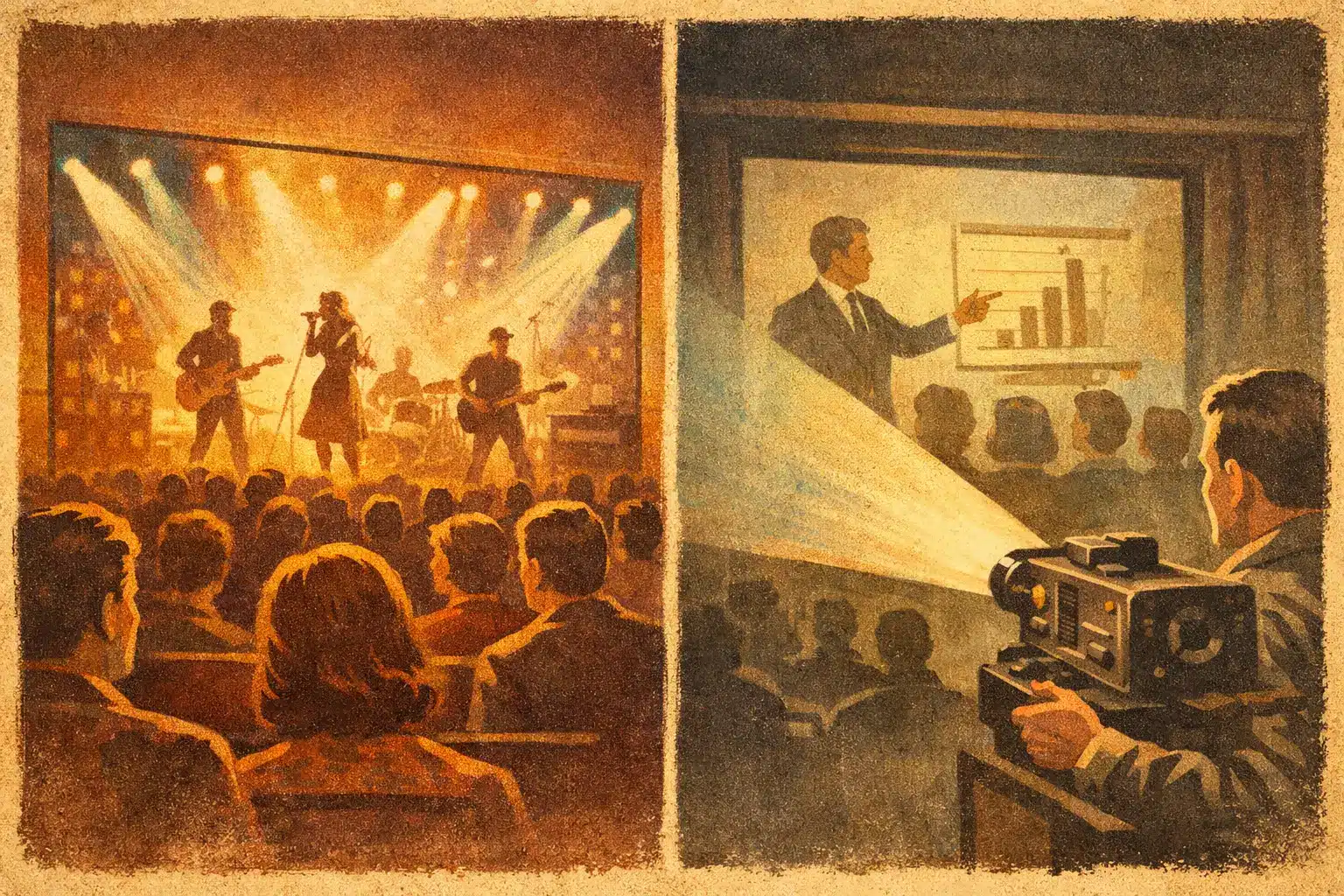
Corporate general sessions and trade shows tend to lean LED because lighting conditions are hard to control and brand presentation matters. Weddings often depend on the venue and the use case. A projector may be ideal for photo montages and speeches in a dim reception space, while LED can be the better fit for high-energy entertainment, custom stage looks, or outdoor receptions.
Concerts, festivals, and public events usually benefit from LED because visibility and impact matter at scale. Breakout rooms, classroom-style sessions, and smaller meetings often remain strong projector territory.
That mix is common across West Coast event markets where one company may support everything from a polished conference in San Francisco to an outdoor activation in Los Angeles or Las Vegas. Different environments call for different tools, and the smartest production plans stay flexible.
The best choice is the one that fits the whole show
The led wall vs projector events decision should never be made from a product sheet alone. It should come from the room conditions, audience size, content type, schedule, and the level of production confidence you need on show day.
At GeoEvent, that usually means asking a few practical questions before recommending gear. Is the room bright? How far back is the audience? What will be on screen? Does the stage design need to make a visual statement? Are we optimizing for value, impact, or a careful balance of both?
If you answer those questions honestly, the right direction becomes much clearer. The screen is not just a piece of equipment. It is part of how your event is seen, understood, and remembered. Choose the option that helps the show land the way you intend.